

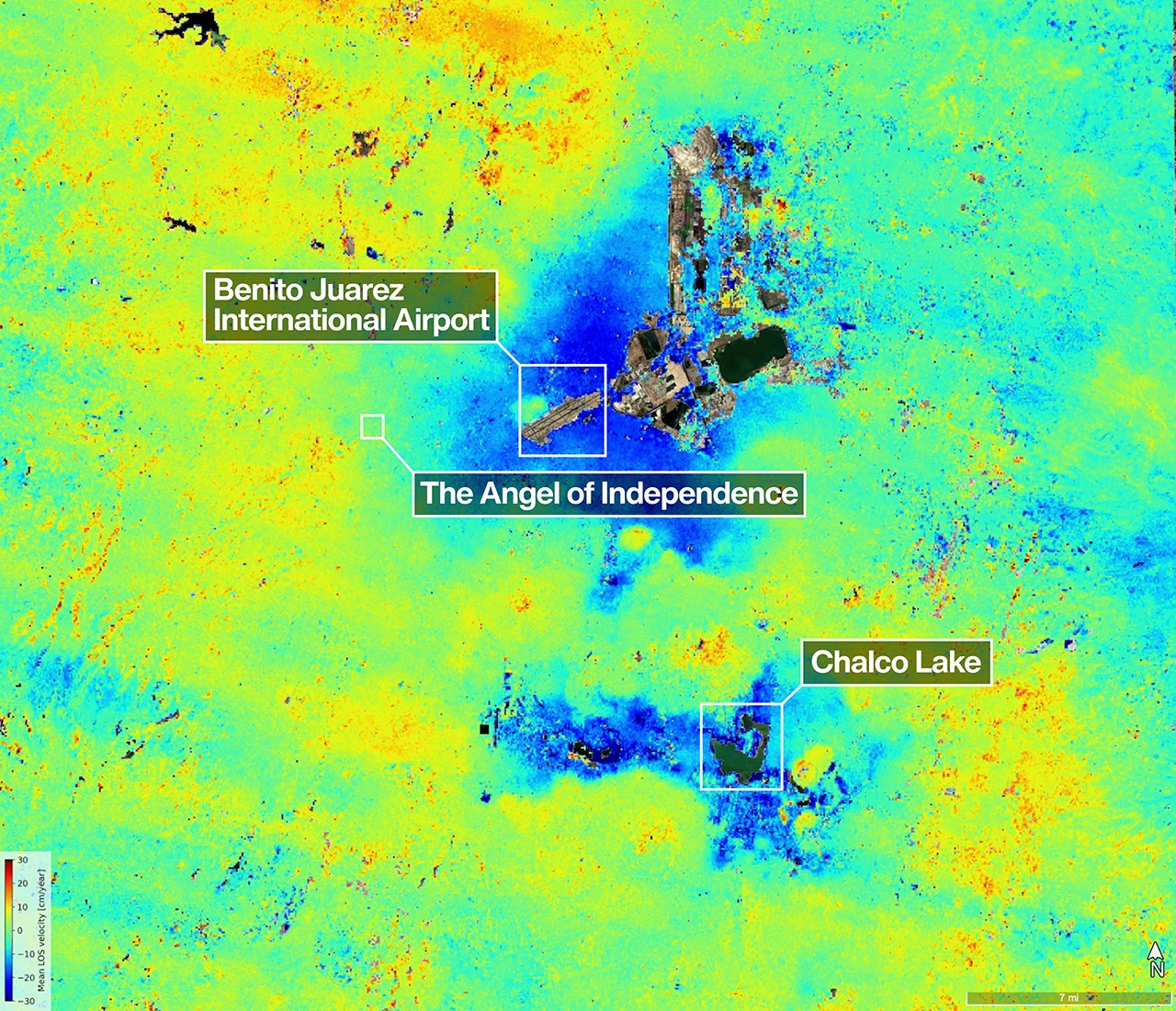
A scientist produced this map of land subsidence (sinking) in Mexico City using data from the NISAR (NASA-ISRO Synthetic Aperture Radar) mission captured between Oct. 25, 2025, and Jan. 17, 2026. The region has been a well-known hot spot of subsidence for decades, and images like this help confirm that NISAR is performing as expected in its first year of operation. The dark blue color indicates areas found to be subsiding by more than half an inch (more than 2 centimeters) per month, due in large part to groundwater pumping, which has led to compaction of the dry, ancient lakebed on which the city was built. The yellow and red areas are likely residual noise signals that are expected to decrease as NISAR collects more data and refines its measurements.
It says one of the main reasons the city is sinking is ground water extraction. Is there any effort to stop this to prevent further sinking? Can they bring in water from elsewhere?
Not really, not economically anyway. It’s one of the most populated cities on the planet and would need a shit ton of water in a place where there just isn’t any. And it’s too far from the coast to be able to use desalinization at such a scale. Realistically that city is doomed. (The city, not the people)
It is even more complex than that. That land was originally a lake, so the city was built in top of that. Then, the extracted water is hard to replenish due to the permeability be near to 0 as it is now an slab of concrete, and due to the heavy construction density and population, after water extraction the soil gets compressed.
Oh I wasn’t talking about fixing their subsidence. That’s unfixable. I was talking about potential ways they could get drinking water without pumping more from under them, exacerbating the issue.
So they just have compounding issues. They’re subsiding, making the amount of atmosphere above them thicker. Much like death valley, it gets extra hot because there’s more blanketing atmosphere above them compared to higher attitudes. So for Mexico City to exist in the future, they need to stop pumping immediately. But that would either kill off millions or cause an exodus like the planet hasn’t seen in millenia. That city is fucked. It would cost way more to bring in enough water to stop pumping, than it’d cost to move the city.
They already do import the water from external sources, mainly the Cutzamala system, which is not quite enough as there are parts of the city that has historically suffered from lack of water supply, like Iztapalapa.
The city is indeed a valley, with an altitud of more than 2k meters above sea level, so meteorogical inversion is a given condicion,
A fix to their issues is to bluntly stop growing (it is expanding), and decentralize the gubernamental institutions there so their related weight can be sparsed along the country, but that is a political debate that may never be opened to discussion
Edit: forgot to mention the heavy rains periods. Being inside a valley, on top of a former lake, and an almost impermeable surface, you can now begin to imagine why the city floods on the rainy season. The sewer system is decades old and in a really bad shape, so the rain mostly has to wait for evaporation (good luck for that during an inversion event)
I am glad not to live there anymore.
