Never heard of such clock. You’ll also need to regularly recalibrate your radioactive sample, because it decreases in weight over time. And you need a Geiger counter to measure that radiation, which is also not super precise.
I went to double check, because I know that’s how atomic clocks work, or maybe there is a now tech I was not aware of but atomic clocks always worked by looking at atomic decay…
WTF
I Swear WTF
I was 100% completely and absolutely wrong. That is not how they have ever worked, and I was sure of that. Like I have a STEM PhD (not physics) and I was sure I looked how they worked at some point and learned it.
But I was extremely wrong, like how TF did I get that idea from and why the fuck have I held on it. Did I dream it? Did someone told me that as a joke and I fell for it? was I learning about decay and half life and I ask myself if that is how they worked and instead of checking I just remembered that as an explanation and not a question???
I feel like a Mandela effect, I would be more conforted knowing that I jumped to a parallel dimension. God. Now I am nervous what other concepts I am 100% confident about yet am full of shit.
Thanks for correcting me, going to have some serious existential crisis, adios

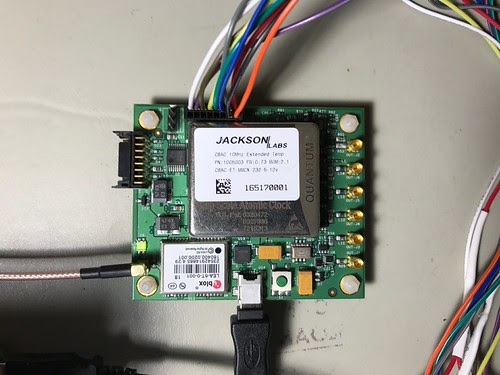
thought some atomic clocks use radioactive decay, inherently random but averages out over time.
Random noise is fine if it averages out.
Never heard of such clock. You’ll also need to regularly recalibrate your radioactive sample, because it decreases in weight over time. And you need a Geiger counter to measure that radiation, which is also not super precise.
A regular crystal oscillator seems better.
I went to double check, because I know that’s how atomic clocks work, or maybe there is a now tech I was not aware of but atomic clocks always worked by looking at atomic decay…
WTF
I Swear WTF
I was 100% completely and absolutely wrong. That is not how they have ever worked, and I was sure of that. Like I have a STEM PhD (not physics) and I was sure I looked how they worked at some point and learned it.
But I was extremely wrong, like how TF did I get that idea from and why the fuck have I held on it. Did I dream it? Did someone told me that as a joke and I fell for it? was I learning about decay and half life and I ask myself if that is how they worked and instead of checking I just remembered that as an explanation and not a question???
I feel like a Mandela effect, I would be more conforted knowing that I jumped to a parallel dimension. God. Now I am nervous what other concepts I am 100% confident about yet am full of shit.
Thanks for correcting me, going to have some serious existential crisis, adios
Wow, that was an intense self-diacovery.
They do use radioactive decay in archeology to measure time, but the precision is within a thousand years.
Probably asdumed that if we model the decay, we could have a good clock. and locked in that concept as true.