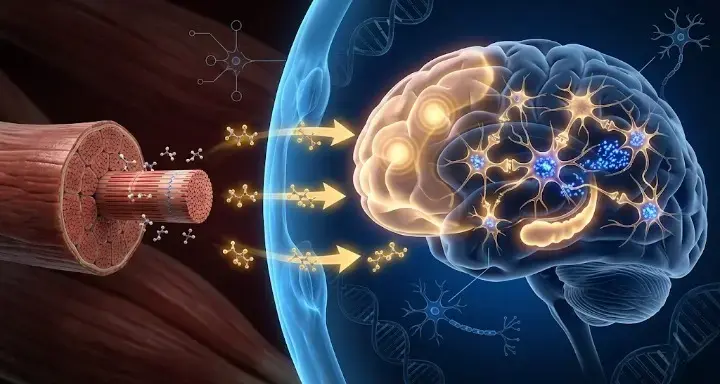
Tens of millions of people take creatine every day for their muscles. A comprehensive review and a landmark clinical trial published in 2025 and 2026 have now documented what the same supplement is quietly doing to their brains. Creatine crosses the blood-brain barrier, raises phosphocreatine levels in neurons, and provides the ATP buffer that keeps cognitive performance from hitting an energy ceiling during demanding mental work. In early Alzheimer's patients, it slowed cognitive decline by approximately 30% versus placebo in a controlled trial. In healthy adults under sleep deprivation, a single dose measurably improved cognitive performance. In depression patients, adding it to cognitive behavioral therapy significantly improved outcomes beyond therapy alone. None of this is mentioned on the label.
Kaptsan, A., Odessky, A., Osher, Y., & Levine, J. (2007). Lack of efficacy of 5 grams daily of creatine in schizophrenia: a randomized, double-blind, placebo-controlled trial. Journal of Clinical Psychiatry, 68(6), 881-884. https://doi.org/10.4088/jcp.v68n0609
Kious, B. M., Sabic, H., Sung, Y. H., Kondo, D. G., & Renshaw, P. (2017). An open-label pilot study of combined augmentation with creatine monohydrate and 5-hydroxytryptophan for selective serotonin reuptake inhibitor–or serotonin-norepinephrine reuptake inhibitor–resistant depression in adult women. Journal of clinical psychopharmacology, 37(5), 578-583. https://doi.org/10.1097/JCP.0000000000000754
Kondo, D. G., Sung, Y. H., Hellem, T. L., Fiedler, K. K., Shi, X., Jeong, E. K., & Renshaw, P. F. (2011). Open-label adjunctive creatine for female adolescents with SSRI-resistant major depressive disorder: a 31-phosphorus magnetic resonance spectroscopy study. Journal of affective disorders, 135(1-3), 354-361. https://doi.org/10.1016/j.jad.2011.07.010
Kondo, D. G., Forrest, L. N., Shi, X., Sung, Y. H., Hellem, T. L., Huber, R. S., & Renshaw, P. F. (2016). Creatine target engagement with brain bioenergetics: a dose-ranging phosphorus-31 magnetic resonance spectroscopy study of adolescent females with SSRI-resistant depression. Amino Acids, 48, 1941-1954. https://doi.org/10.1007/s00726-016-2194-3
Krahe, R., & Gabbiani, F. (2004). Burst firing in sensory systems. Nature Reviews Neuroscience, 5(1), 13–23. https://doi.org/10.1038/nrn1296
Leichsenring, F., Steinert, C., Rabung, S., & Ioannidis, J. P. A. (2022). The efficacy of psychotherapies and pharmacotherapies for mental disorders in adults: an umbrella review and meta-analytic evaluation of recent meta-analyses. World psychiatry : official journal of the World Psychiatric Association (WPA), 21(1), 133–145. https://doi.org/10.1002/wps.20941
Levental, U., Bersudsky, Y., Dwalatzky, T., Lerner, V., Medina, S., & Levine, J. (2015). A pilot open study of long term high dose creatine augmentation in patients with treatment resistant negative symptoms schizophrenia. Israel Journal of Psychiatry, 52(1), 6. https://pubmed.ncbi.nlm.nih.gov/25841104/
Lyoo, I. K., Yoon, S., Kim, T. S., Hwang, J., Kim, J. E., Won, W., Bae, S., & Renshaw, P. F. (2012). A randomized, double-blind placebo-controlled trial of oral creatine monohydrate augmentation for enhanced response to a selective serotonin reuptake inhibitor in women with major depressive disorder. The American journal of psychiatry, 169(9), 937–945. https://doi.org/10.1176/appi.ajp.2012.12010009
Mason, S. (2017). Lactate shuttles in neuroenergetics—Homeostasis, allostasis and beyond. Frontiers in Neuroscience, 11, 43. https://doi.org/10.3389/fnins.2017.00043
McMorris, T., Harris, R. C., Swain, J., Corbett, J., Collard, K., Dyson, R. J., Dye, L., Hodgson, C., & Draper, N. (2006). Effect of creatine supplementation and sleep deprivation, with mild exercise, on cognitive and psychomotor performance, mood state, and plasma concentrations of catecholamines and cortisol. Psychopharmacology, 185(1), 93–103. https://doi.org/10.1007/s00213-005-0269-z
McMorris, T., Harris, R. C., Howard, A. N., Langridge, G., Hall, B., Corbett, J., Dicks, M., & Hodgson, C. (2007). Creatine supplementation, sleep deprivation, cortisol, melatonin and behavior. Physiology & Behavior, 90(1), 21–28. https://doi.org/10.1016/j.physbeh.2006.08.024
Munn, Z., Pollock, D., Khalil, H., Alexander, L., Mclnerney, P., Godfrey, C. M., Peters, M., & Tricco, A. C. (2022). What are scoping reviews? Providing a formal definition of scoping reviews as a type of evidence synthesis. JBI evidence synthesis, 20(4), 950–952. https://doi.org/10.11124/JBIES-21-00483
Nemets, B., & Levine, J. (2013). A pilot dose-finding clinical trial of creatine monohydrate augmentation to SSRIs/SNRIs/NASA antidepressant treatment in major depression. International clinical psychopharmacology, 28(3), 127-133. https://doi.org/10.1097/YIC.0b013e32835ff20f
Pan, J. W., & Takahashi, K. (2007). Cerebral energetic effects of creatine supplementation in humans. American Journal of Physiology-Regulatory, Integrative and Comparative Physiology, 292(4), R1745-R1750. https://doi.org/10.1152/ajpregu.00717.2006
Peters, M. D., Godfrey, C. M., Khalil, H., McInerney, P., Parker, D., & Soares, C. B. (2015). Guidance for conducting systematic scoping reviews. International journal of evidence-based healthcare, 13(3), 141–146. https://doi.org/10.1097/XEB.0000000000000050
Poortmans, J. R., & Francaux, M. (1999). Long-term oral creatine supplementation does not impair renal function in healthy athletes. Medicine and science in sports and exercise, 31(8), 1108-1110. https://doi.org/10.1097/00005768-199908000-00005
Prokopidis, K., Giannos, P., Triantafyllidis, K. K., Kechagias, K. S., Forbes, S. C., & Candow, D. G. (2023). Effects of creatine supplementation on memory in healthy individuals: a systematic review and meta-analysis of randomized controlled trials. Nutrition reviews, 81(4), 416–427. https://doi.org/10.1093/nutrit/nuac064
Roitman, S., Green, T., Osher, Y., Karni, N., & Levine, J. (2007). Creatine monohydrate in resistant depression: a preliminary study. Bipolar Disorders, 9(7), 754-758. https://doi.org/10.1111/j.1399-5618.2007.00532.x
Sherpa, N. N., De Giorgi, R., Ostinelli, E. G., Choudhury, A., Dolma, T., & Dorjee, S. (2025). Efficacy and safety profile of oral creatine monohydrate in add-on to cognitive-behavioural therapy in depression: An 8-week pilot, double-blind, randomised, placebo-controlled feasibility and exploratory trial in an under-resourced area. European Neuropsychopharmacology, 90, 28-35.https://doi.org/10.1016/j.euroneuro.2024.10.004
Smith, A. N., Morris, J. K., Carbuhn, A. F., Keller, J. E., Sullivan, D. K., & Taylor, M. K. (2023). Creatine as a therapeutic target in Alzheimer’s disease. Current Developments in Nutrition, 7(11), 102011. https://doi.org/10.1016/j.cdnut.2023.102011
Sullivan, P. G., Geiger, J. D., Mattson, M. P., & Scheff, S. W. (2000). Dietary supplement creatine protects against traumatic brain injury. Annals of neurology, 48(5), 723–729. https://pubmed.ncbi.nlm.nih.gov/11079535/
Toniolo, R. A., Fernandes, F. B. F., Silva, M., Dias, R. D. S., & Lafer, B. (2017). Cognitive effects of creatine monohydrate adjunctive therapy in patients with bipolar depression: Results from a randomized, double-blind, placebo-controlled trial. Journal of affective disorders, 224, 69–75. https://doi.org/10.1016/j.jad.2016.11.029
Toniolo, R. A., Silva, M., Fernandes, F. D. B. F., Amaral, J. A. D. M. S., Dias, R. D. S., & Lafer, B. (2018). A randomized, double-blind, placebo-controlled, proof-of-concept trial of creatine monohydrate as adjunctive treatment for bipolar depression. Journal of Neural Transmission, 125, 247-257. https://doi.org/10.1007/s00702-017-1817-5
Tricco, A. C., Lillie, E., Zarin, W., O’Brien, K. K., Colquhoun, H., Levac, D., Moher, D., Peters, M. D. J., Horsley, T., Weeks, L., Hempel, S., Akl, E. A., Chang, C., McGowan, J., Stewart, L., Hartling, L., Aldcroft, A., Wilson, M. G., Garritty, C., Lewin, S., … Straus, S. E. (2018). PRISMA Extension for Scoping Reviews (PRISMA-ScR): Checklist and Explanation. Annals of internal medicine, 169(7), 467–473. https://doi.org/10.7326/M`18-0850
Turner, C. E., Byblow, W. D., & Gant, N. (2015). Creatine supplementation enhances corticomotor excitability and cognitive performance during oxygen deprivation. The Journal of Neuroscience, 35(4), 1773–1780. https://doi.org/10.1523/JNEUROSCI.3113-14.2015
Vittengl, J. R., Clark, L. A., Smits, J. A., Thase, M. E., & Jarrett, R. B. (2019). Do comorbid social and other anxiety disorders predict outcomes during and after cognitive therapy for depression? Journal of Affective Disorders, 242, 150–158. https://doi.org/10.1016/j.jad.2018.08.036
Walsh, B., Tonkonogi, M., Söderlund, K., Hultman, E., Saks, V., & Sahlin, K. (2001). The role of phosphorylcreatine and creatine in the regulation of mitochondrial respiration in human skeletal muscle. The Journal of physiology, 537(3), 971-978.https://doi.org/10.1111/j.1469-7793.2001.00971.x
Xu, C., Bi, S., Zhang, W., & Luo, L. (2024). The effects of creatine supplementation on cognitive function in adults: A systematic review and meta-analysis. Frontiers in Nutrition, 11. https://doi.org/10.3389/fnut.2024.1424972
Yang, L., Calingasan, N. Y., Wille, E. J., Cormier, K., Smith, K., Ferrante, R. J., & Flint Beal, M. (2009). Combination therapy with coenzyme Q10 and creatine produces additive neuroprotective effects in models of Parkinson’s and Huntington’s diseases. Journal of neurochemistry, 109(5), 1427-1439. https://doi.org/10.1111/j.1471-4159.2009.06074.x
Yoon, S., Kim, J. E., Hwang, J., Kim, T. S., Kang, H. J., Namgung, E., Ban, S., Oh, S., Yang, J., Renshaw, P. F., & Lyoo, I. K. (2016). Effects of creatine monohydrate augmentation on brain metabolic and network outcome measures in women with major depressive disorder. Biological Psychiatry, 80(6), 439–447. https://doi.org/10.1016/j.biopsych.2015.11.027

Kaptsan, A., Odessky, A., Osher, Y., & Levine, J. (2007). Lack of efficacy of 5 grams daily of creatine in schizophrenia: a randomized, double-blind, placebo-controlled trial. Journal of Clinical Psychiatry, 68(6), 881-884. https://doi.org/10.4088/jcp.v68n0609
Kious, B. M., Sabic, H., Sung, Y. H., Kondo, D. G., & Renshaw, P. (2017). An open-label pilot study of combined augmentation with creatine monohydrate and 5-hydroxytryptophan for selective serotonin reuptake inhibitor–or serotonin-norepinephrine reuptake inhibitor–resistant depression in adult women. Journal of clinical psychopharmacology, 37(5), 578-583. https://doi.org/10.1097/JCP.0000000000000754
Kondo, D. G., Sung, Y. H., Hellem, T. L., Fiedler, K. K., Shi, X., Jeong, E. K., & Renshaw, P. F. (2011). Open-label adjunctive creatine for female adolescents with SSRI-resistant major depressive disorder: a 31-phosphorus magnetic resonance spectroscopy study. Journal of affective disorders, 135(1-3), 354-361. https://doi.org/10.1016/j.jad.2011.07.010
Kondo, D. G., Forrest, L. N., Shi, X., Sung, Y. H., Hellem, T. L., Huber, R. S., & Renshaw, P. F. (2016). Creatine target engagement with brain bioenergetics: a dose-ranging phosphorus-31 magnetic resonance spectroscopy study of adolescent females with SSRI-resistant depression. Amino Acids, 48, 1941-1954. https://doi.org/10.1007/s00726-016-2194-3
Krahe, R., & Gabbiani, F. (2004). Burst firing in sensory systems. Nature Reviews Neuroscience, 5(1), 13–23. https://doi.org/10.1038/nrn1296
Leichsenring, F., Steinert, C., Rabung, S., & Ioannidis, J. P. A. (2022). The efficacy of psychotherapies and pharmacotherapies for mental disorders in adults: an umbrella review and meta-analytic evaluation of recent meta-analyses. World psychiatry : official journal of the World Psychiatric Association (WPA), 21(1), 133–145. https://doi.org/10.1002/wps.20941
Levental, U., Bersudsky, Y., Dwalatzky, T., Lerner, V., Medina, S., & Levine, J. (2015). A pilot open study of long term high dose creatine augmentation in patients with treatment resistant negative symptoms schizophrenia. Israel Journal of Psychiatry, 52(1), 6. https://pubmed.ncbi.nlm.nih.gov/25841104/
Lyoo, I. K., Yoon, S., Kim, T. S., Hwang, J., Kim, J. E., Won, W., Bae, S., & Renshaw, P. F. (2012). A randomized, double-blind placebo-controlled trial of oral creatine monohydrate augmentation for enhanced response to a selective serotonin reuptake inhibitor in women with major depressive disorder. The American journal of psychiatry, 169(9), 937–945. https://doi.org/10.1176/appi.ajp.2012.12010009
Mason, S. (2017). Lactate shuttles in neuroenergetics—Homeostasis, allostasis and beyond. Frontiers in Neuroscience, 11, 43. https://doi.org/10.3389/fnins.2017.00043
McMorris, T., Harris, R. C., Swain, J., Corbett, J., Collard, K., Dyson, R. J., Dye, L., Hodgson, C., & Draper, N. (2006). Effect of creatine supplementation and sleep deprivation, with mild exercise, on cognitive and psychomotor performance, mood state, and plasma concentrations of catecholamines and cortisol. Psychopharmacology, 185(1), 93–103. https://doi.org/10.1007/s00213-005-0269-z
McMorris, T., Harris, R. C., Howard, A. N., Langridge, G., Hall, B., Corbett, J., Dicks, M., & Hodgson, C. (2007). Creatine supplementation, sleep deprivation, cortisol, melatonin and behavior. Physiology & Behavior, 90(1), 21–28. https://doi.org/10.1016/j.physbeh.2006.08.024
Miller, E. (2022, October 15). Metabolic pathways explained. Cleveland Clinic. https://health.clevelandclinic.org/metabolic-pathways-metabolic-conditioning
Munn, Z., Pollock, D., Khalil, H., Alexander, L., Mclnerney, P., Godfrey, C. M., Peters, M., & Tricco, A. C. (2022). What are scoping reviews? Providing a formal definition of scoping reviews as a type of evidence synthesis. JBI evidence synthesis, 20(4), 950–952. https://doi.org/10.11124/JBIES-21-00483
Nemets, B., & Levine, J. (2013). A pilot dose-finding clinical trial of creatine monohydrate augmentation to SSRIs/SNRIs/NASA antidepressant treatment in major depression. International clinical psychopharmacology, 28(3), 127-133. https://doi.org/10.1097/YIC.0b013e32835ff20f
Pan, J. W., & Takahashi, K. (2007). Cerebral energetic effects of creatine supplementation in humans. American Journal of Physiology-Regulatory, Integrative and Comparative Physiology, 292(4), R1745-R1750. https://doi.org/10.1152/ajpregu.00717.2006
Peters, M. D., Godfrey, C. M., Khalil, H., McInerney, P., Parker, D., & Soares, C. B. (2015). Guidance for conducting systematic scoping reviews. International journal of evidence-based healthcare, 13(3), 141–146. https://doi.org/10.1097/XEB.0000000000000050
Poortmans, J. R., & Francaux, M. (1999). Long-term oral creatine supplementation does not impair renal function in healthy athletes. Medicine and science in sports and exercise, 31(8), 1108-1110. https://doi.org/10.1097/00005768-199908000-00005
Prokopidis, K., Giannos, P., Triantafyllidis, K. K., Kechagias, K. S., Forbes, S. C., & Candow, D. G. (2023). Effects of creatine supplementation on memory in healthy individuals: a systematic review and meta-analysis of randomized controlled trials. Nutrition reviews, 81(4), 416–427. https://doi.org/10.1093/nutrit/nuac064
Roitman, S., Green, T., Osher, Y., Karni, N., & Levine, J. (2007). Creatine monohydrate in resistant depression: a preliminary study. Bipolar Disorders, 9(7), 754-758. https://doi.org/10.1111/j.1399-5618.2007.00532.x
Sherpa, N. N., De Giorgi, R., Ostinelli, E. G., Choudhury, A., Dolma, T., & Dorjee, S. (2025). Efficacy and safety profile of oral creatine monohydrate in add-on to cognitive-behavioural therapy in depression: An 8-week pilot, double-blind, randomised, placebo-controlled feasibility and exploratory trial in an under-resourced area. European Neuropsychopharmacology, 90, 28-35.https://doi.org/10.1016/j.euroneuro.2024.10.004
Smith, A. N., Morris, J. K., Carbuhn, A. F., Keller, J. E., Sullivan, D. K., & Taylor, M. K. (2023). Creatine as a therapeutic target in Alzheimer’s disease. Current Developments in Nutrition, 7(11), 102011. https://doi.org/10.1016/j.cdnut.2023.102011
Sullivan, P. G., Geiger, J. D., Mattson, M. P., & Scheff, S. W. (2000). Dietary supplement creatine protects against traumatic brain injury. Annals of neurology, 48(5), 723–729. https://pubmed.ncbi.nlm.nih.gov/11079535/
Toniolo, R. A., Fernandes, F. B. F., Silva, M., Dias, R. D. S., & Lafer, B. (2017). Cognitive effects of creatine monohydrate adjunctive therapy in patients with bipolar depression: Results from a randomized, double-blind, placebo-controlled trial. Journal of affective disorders, 224, 69–75. https://doi.org/10.1016/j.jad.2016.11.029
Toniolo, R. A., Silva, M., Fernandes, F. D. B. F., Amaral, J. A. D. M. S., Dias, R. D. S., & Lafer, B. (2018). A randomized, double-blind, placebo-controlled, proof-of-concept trial of creatine monohydrate as adjunctive treatment for bipolar depression. Journal of Neural Transmission, 125, 247-257. https://doi.org/10.1007/s00702-017-1817-5
Tricco, A. C., Lillie, E., Zarin, W., O’Brien, K. K., Colquhoun, H., Levac, D., Moher, D., Peters, M. D. J., Horsley, T., Weeks, L., Hempel, S., Akl, E. A., Chang, C., McGowan, J., Stewart, L., Hartling, L., Aldcroft, A., Wilson, M. G., Garritty, C., Lewin, S., … Straus, S. E. (2018). PRISMA Extension for Scoping Reviews (PRISMA-ScR): Checklist and Explanation. Annals of internal medicine, 169(7), 467–473. https://doi.org/10.7326/M`18-0850
Turner, C. E., Byblow, W. D., & Gant, N. (2015). Creatine supplementation enhances corticomotor excitability and cognitive performance during oxygen deprivation. The Journal of Neuroscience, 35(4), 1773–1780. https://doi.org/10.1523/JNEUROSCI.3113-14.2015
Vittengl, J. R., Clark, L. A., Smits, J. A., Thase, M. E., & Jarrett, R. B. (2019). Do comorbid social and other anxiety disorders predict outcomes during and after cognitive therapy for depression? Journal of Affective Disorders, 242, 150–158. https://doi.org/10.1016/j.jad.2018.08.036
Walsh, B., Tonkonogi, M., Söderlund, K., Hultman, E., Saks, V., & Sahlin, K. (2001). The role of phosphorylcreatine and creatine in the regulation of mitochondrial respiration in human skeletal muscle. The Journal of physiology, 537(3), 971-978.https://doi.org/10.1111/j.1469-7793.2001.00971.x
World Health Organization (WHO). (2022). Mental disorders Fact Sheet. Retrieved March 3, 2025 from https://www.who.int/news-room/fact-sheets/detail/mental-disorders
Xu, C., Bi, S., Zhang, W., & Luo, L. (2024). The effects of creatine supplementation on cognitive function in adults: A systematic review and meta-analysis. Frontiers in Nutrition, 11. https://doi.org/10.3389/fnut.2024.1424972
Yang, L., Calingasan, N. Y., Wille, E. J., Cormier, K., Smith, K., Ferrante, R. J., & Flint Beal, M. (2009). Combination therapy with coenzyme Q10 and creatine produces additive neuroprotective effects in models of Parkinson’s and Huntington’s diseases. Journal of neurochemistry, 109(5), 1427-1439. https://doi.org/10.1111/j.1471-4159.2009.06074.x
Yoon, S., Kim, J. E., Hwang, J., Kim, T. S., Kang, H. J., Namgung, E., Ban, S., Oh, S., Yang, J., Renshaw, P. F., & Lyoo, I. K. (2016). Effects of creatine monohydrate augmentation on brain metabolic and network outcome measures in women with major depressive disorder. Biological Psychiatry, 80(6), 439–447. https://doi.org/10.1016/j.biopsych.2015.11.027