

If needed I will try to explain further.
The escape velocity for the Earth is 11.2 km/s. If you shoot a cannonball upward at that speed, it’ll have enough energy to completely leave Earth and never come back.
Yes, but there is air resistance. And as mentioned in the question, you can use moon to slingshot the object. Also, I guess it is better to accelerate during the ascendancy, probably because of the friction, otherwise rockets would be replaced with cannons.
The Tyranny of the Rocket Equation
And, if your curiosity goes beyond that basic explanation, check out this NASA page on rocket launches:
If a spacecraft is launched from a site near Earth’s equator, it can take optimum advantage of the Earth’s substantial rotational speed. Sitting on the launch pad near the equator, it is already moving at a speed of over 1650 km per hour relative to Earth’s center. This can be applied to the speed required to orbit the Earth (approximately 28,000 km per hour).
Getting into orbit doesn’t just require overcoming the force of gravity pulling down. In order to stay up, you basically have to put yourself on a path that allows you to go around the Earth faster (or as fast as) you fall back towards it. When your movement around the Earth is balanced with the rate that you’re falling, you are in orbit. This means you have to go really fucking fast, not just up but sideways.
I have a sense of what you’re saying. So other comments have already pointed out the escape velocity, and those are true. But I think I can expand upon this a bit.
So the weird thing about rocketry is that distances are insane. Like, whatever you think the distance is between 2 astronomical objects, the actual distance is probably at least 10 times that.
This, coupled with the fact that there’s no friction in space, leads to a very unusual way of traveling. In space, if you want to go somewhere, you point your rocket in the direction that you want to go, fire the rocket up to get up to the correct speed, then just drift the rest of the way to your destination. The fact that you can just drift to different locations means that you don’t actually need to keep using up fuel for the entire trip. You only need to use fuel once, at the beginning to get to the right speed.
In physics, this type of motion, where an object (a rocket in this case) drifts for most of the time, and suddenly changes direction in a relatively short span of time, is called impulse. So when we talk about rockets and how much “force” we need to get to places, what we’re really asking is how much impulse we need to get to the correct speed that’ll take us to where we want to go. Impulse is measured in what’s called delta-v, which is essentially a measure of “how much can we speed up.”
There’s actually delta-v maps for the solar system. So if you want to go to this location, you need to spend this amount of delta-v to get up to the correct speed that’ll take you there. It’s an approximate map - you’ll need to do per-mission simulations to get the exact delta-v values - but it’s a good enough estimate for general usage. To use it, you start at your current location, then trace a path to where you want to go. And you just add up all the numbers that you see along the way.
The escape velocity number is the delta-v required to leave Earth’s orbit (earth -> low earth orbit -> earth intercept)
If you want to go to the moon, you do the same thing. Earth -> low earth orbit -> moon intercept -> low moon orbit -> moon
The posts about escape velocity (or speed if you prefer) are correct. To that I want to add the following: Gravitational effects technically never end with distance, only become weaker. It’s also important to note that every object has a gravitational field, it’s just that it needs to be ridiculously big for the force to have any real effect. Gravitational force can be described by the following equation:

where r is the distance between the two objects, and the rest does not matter for us today.This is the same as the inverse square law of light (this is a pretty good visual):
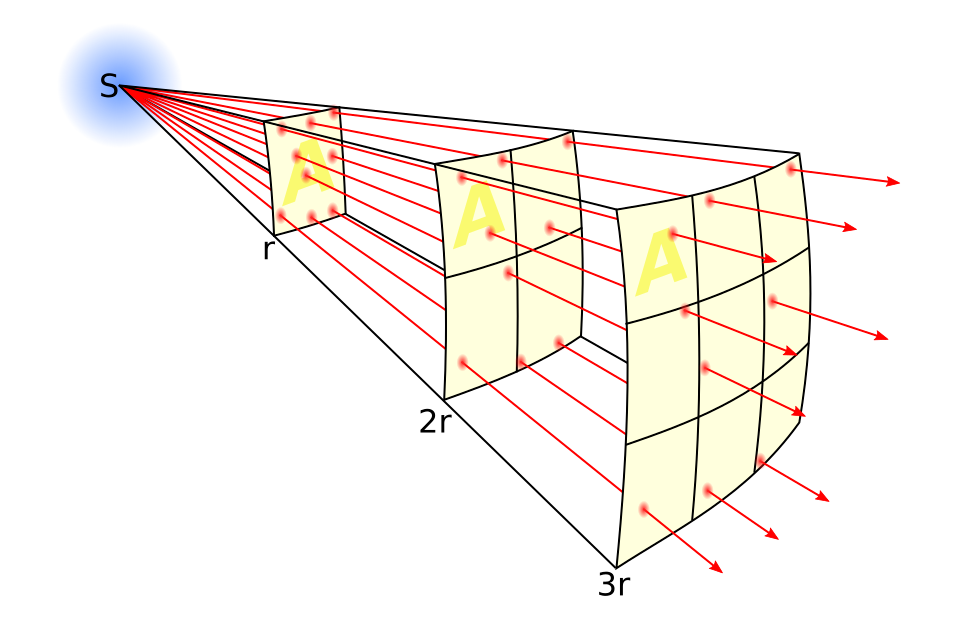
This means if you double the distance between yourself and a star, the strength of its light reaching you will quarter. This is also very similar to the math used to describe electric and magnetic field interactions, but I won’t go into that today.
This is why scientists are able to measure gravitational waves from collapsing stars and quasars and stuff at the LIGO Gravitational Wave Observatory, just like how we can observe the light coming from distant stars. However, there is a point where the force of gravity becomes so weak as to be inconsequential, just like how at the edge of the solar system, the sun merely looks like a bright star. That is described as the gravitational sphere of influence, the rough approximation of the distance from a celestial body where it exerts the most gravitational force on a given object.
Escape speed is the speed at which an object must travel, given a distance from said body, to escape its sphere of influence. The Earth+moon have a sphere of influence of about 9.29E5 km.
You need to move at a speed of 4km/s.
Right idea, wrong number. Satellites in low Earth orbit are typically moving at about 7-8 km/s, depending on the exact altitude. The speed required to get from the surface to deep space (i.e., the “escape velocity”) is 11.2 km/s.
