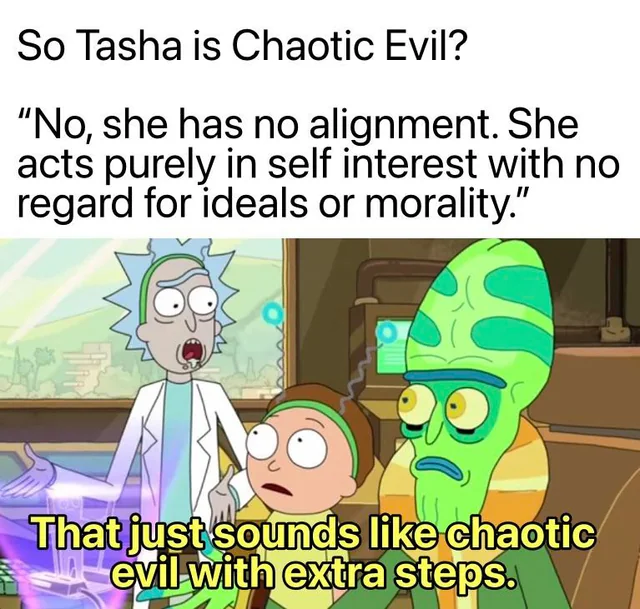

Isn’t acting purely in self interest the general definition of chaotic neutral?
If while acting in your own self-interest you knowingly, through action or inaction, allow others to come to harm, even indirectly, that is evil. In the same way that a character knowingly doing something that benefits others would arguably make them good. A chaotic neutral person may act on a whim or in self-interest the majority of the time, but I doubt they’d let their actions cause actual harm to others.
But trying to pigeonhole human behavior into a rigid matrix of alignments is inherently flawed, people are much more complex than that. Fortunately, DND allows the DM free reign to define that or allow it to be a grey area - in reality, “alignment” will always be fluid.
Isn’t self interest without regard to anything else true neutral? Good would mean helping people, evil would mean hurting people. Lawful means following the laws, chaotic means rebelling against laws. True neutral has no regard for anyone else and no regard for laws.
Lawful doesn’t mean following the laws. A lawful person isn’t obligated to follow the law in the Kingdom of Baby Eating.
Lawful means you obey the rules. However, presumably you have your own set of ethics, as well as probably the belief in a god that also has their own rules. You have to reconcile these. Obviously if your god is about protecting innocent lives and you think the babies being eaten are innocent and deserve protection, you probably aren’t going to obey all the laws in the KoBE.
This is the classic theological definition of evil. Evil isn’t the anti-good, it’s the absence of good. Good is typically regarded as some kind of selflessness or care for other, so evil is basically selfishness. There’s nuance, but I wanted to support the challenge to dualistic world view.
A “theological” definition doesn’t really work in a world where there are actual gods and some of them actively want to cause suffering. The theology of D&D (and most other fantasy settings) is not the theology of Earth Christianity of the 21st century.