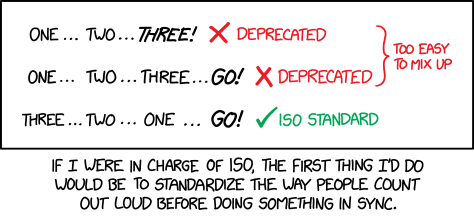
xkcd #3232: Countdown Standard
Title text:
Anyone who is caught counting ‘three … two … one … zero … GO!’ will be punished with a lifetime of eating only ISO standard food samples.
Transcript:
Transcript will show once it’s been added to explainxkcd.com
Source: https://xkcd.com/3232/
You must log in or register to comment.
Real ones know to go on the “t” of “three”
What about 3, 2, 1, 0, segfault?
Playing Chained Together we had so many jumps that a full count was too long, so we took out the 3 entirely and counted fast. “2 1 Go! 2 1 Go!” Very successful. That game even counts for you if you press the hotkey, but it takes five full seconds, and there’s lava rising down there!

In Finnish we typically say "Än, yy, tee, nyt!", because our word for "now", nyt, is composed of letters N, Y and T.
The “y” is pronounced roughly the same way as “ew” in “new”. “ä” in the same as “a” in “cat”, and “e” is the same as “e” in “well”.
How about translating this to English and using the following as the standard?
"Aehn, oh, double you, now!"
🙃
The three syllable ‘w’ kinda ruins it.
Eh everyone says “dubya” anyways
Still, all other letters only clock 1 syllable. I vote we just go ahead and change the standard to “dub”.
But if we do that, we’ll need a new alphabet song!
(also, since letters [sorta] contain their respective sounds, I suggest “wub”)
Holy shit, is that why people call george w bush dubya? As a non native English speaker I wouldn’t have thought of that in a million years
One, two, five!
Unconfusable:
Ready, Set, Go!
Ready, set, on your mark, get set, get ready, here, we …
Saying “on the count of three” before you start counting is optimal, in timelines where that tradition is widely known. It’s more words the first time but many people need the time provided by saying them to mentally prepare, and then if you need repeated counts no such preparation is necessary and each one takes only three beats.
Left out the Arthurian “One… Two… Five… No, Three… Go!”
I just say “THREE!”. It’s the “ONE TWO THREE!” variant but I skip “ONE” and “TWO”.
If you’re not ready now, you won’t be after the count down.
I’m a theatre tech and stagehand. “Go” is saved for cue calls. It’s always lift on three. One two THREE.
LX7 Standby
Standing
It always tickles me when I come across people with enough comms etiquette to not say “Go” unless they are giving a cue. “I’ll wait for you to say G. O. before I do anything”
My favorite thing is the ability for most if not all hands on comms to have the most random conversations and then stop cold as soon as “standby…” Is heard. Then after all the cues have been given, the conversation picks up exactly wherever it left off.
The real problem in my opinion is people count too slowly and irregularly for a precise sync up. Better to learn from the world of music and count off
One ee and ah, two ee and ah, three ee and ah GO
This is why you have a practice count! “On three, everybody… one, two, three!”
“Okay, got that? Here we go: one, two… three!”
You can count me in like that but I insist a full measure of Mars, Bringer of War.
Se… No !

Has the XKCD guy been nostalgia-watching *Bring It On"?
Or Red vs Blue S1?
“Wait, on three or three and then go?” “On three. It’s always faster to go on three”
This, and standardizing what “this Thursday” and “next Thursday” mean. These terms have become functionally useless (to me) because of how they’re used differently by different people. Whenever someone uses these terms to try to intimate a particular date to me, I just ask for the exact calendar date rather than the day of the week to avoid ambiguity.
Biweekly is another one. Two times a week, or once every two weeks (also called a fortnight)?
Check the podcast episode “A Problem Squared - 121 = Bi-annuals and Diagonals”. In it, Matt and Beck discuss what these terms even mean, and propose a solution.
Fortnightly already exists as a term though, why would biweekly mean the same thing?
We can have more than one way of describing things. Sometimes there is subtle nuances between the words.
No one ever uses fortnightly though. I have a hard time even remembering what it means as it’s never used.
Americans never use fortnight. I suspect this is because very few get to enjoy 2 weeks of uninterrupted vacation.
There’s also semi monthly, which is two times a month, as opposed to every two weeks, which is what biweekly is
Semi monthly results in 24 events per year while biweekly events happen 26 times
Approximately 26 times a year.
I can’t express the amount of visceral discomfort this brought me.
This is one of those ones that’s a tragedy. Biweekly “should” always mean every two weeks. Twice a week is “semi-weekly”, aka every half a week.
But regardless of what it “should” mean, people use it wrong often enough that you have to check every time, not because the word is ambiguous, but because people are often mistaken.
It’s a shame, but it’s part of human communication 😅
Human communication sucks. It should be illegal.
Tell me about it.
sorry that’s illegal
There is a rule but it’s not really well known so people just follow whatever rule they deduced from usage. People have to qualify which one they mean almost every time. I usually say “this coming Thursday” (this week), or “Thursday next week” instead.
I find Thursday (for this week) and Thursday next (for next week) adequate and am seldom called on for clarification, seems to follow the pattern of the rule (thanks for that) but is more economical.
The rule makes perfect sense (and is how I’ve always used it), but this article actually misses a major point which I just learned last week when talking to some native Spanish speakers. In most English speaking countries, the week starts on Sunday. This isn’t the case for many, many other countries though. So saying “this Friday” on a Sunday really really confuses people. That’s exactly what happened to me last week because it was a Sunday and we were talking about a Friday and she got very very confused.
Starting the week on Sunday makes zero sense. Where does that even come from? Obviously Monday is the start of the week and everyone hates it for it.
why does monday makes more sense than sunday?
Excellent point. Same for most European countries, I think.
Another date confusion things is weeks. Europeans use week numbers a lot (“I’m on vacation weeks 34-37”) but that’s very rare in the US. And the week numbers aren’t (always) the same anyway. In the US we use “I’m on vacation the week of <date>”, which honestly is a lot easier to understand without referencing a calendar.
The day of the week shouldn’t matter, it’s either the Sunday that is coming up next or the one exactly a week after it. “This Sunday” should be the upcoming one and “Next Sunday” should be the one after. Doesn’t matter if it’s this week, next week or in two weeks.
Another problem is that system requires agreeing on what a week is, and there’s disagreement over whether Sunday starts or ends the week.
“upcoming Thursday” is the way I try to solve that
- “This Thursday” is for the Thursday contained within the Sunday–Saturday interval you’re currently in.
- “Next Thursday” means, starting from 00:00 on a given Thursday, the first Thursday you hit (not including the one you’re on if applicable) as you go forward in time from that point.
- They aren’t mutually exclusive.
Is this not universal? It seems so obvious.
- If it’s a Friday, “this Thursday” is the one from a day ago, and “next Thursday” is six days from now.
- If it’s a Tuesday, “this Thursday” and “next Thursday” are both two days from now.
- If it’s a Thursday, then “this Thursday” is today (albeit weird), and “next Thursday” is seven days from now.
So if it’s a Friday, “This Thursday” was yesterday? How does that make sense?
“This Thursday” is always the upcoming Thursday.
Last Thursday was fucking yesterday.I feel strongly that “next” Thursday should be not the next instance of a Thursday but rather the first instance of a Thursday past the contained set of the current week (so the next row on a calendar). I.e. if it’s Tuesday, “next Thursday” isn’t the Thursday two days from now but the Thursday 9 days from now.
For many, “next Thursday” is the next available Thursday, three days hence (if you’re reading this on a Monday)
three days hence
What the fuck. 😭 But “next Thursday” clearly has a well-defined 7-day period. Given a bus stop with 20 minutes between buses, the “next bus” doesn’t just start arbitrarily applying 10 minutes after the last bus left. Who would use it like this??
This doesn’t make sense from a linguistics standpoint though. So next Thursday is the Thursday this week, but next week isn’t this week, it’s the week after this one. So what’s the Thursday in that week, the next next Thursday? It just doesn’t work.
Anything in this week (Sunday-Saturday or Monday-Sunday) even stuff from a few days ago -> this <day of the week>.
Anything from last week -> last <dotw>
Anything in next week -> next <dotw>
It’s incredibly simple and it’s logically consistent and it works in every situation unless you are talking to someone from a different country that uses a different starting day. And even then it works the majority of the time.
You’re trying to apply logic to English? You’re also assuming people actually think about what they’re saying or even know the so called rules of English. If that were the case we wouldn’t have people mixing up their/there/they’re or your/you’re its/it’s etc.
Fact of the matter, if everything you said were true, we wouldn’t have people wishing for a way to clarify and we wouldn’t be having this conversation.
Wrong. Weeks start on Monday. Sunday is the last day of the week. A week is 5 work days and 2 days of the weekend. I will have none of this Sunday bs.
“This Thursday” is for the Thursday contained within the Sunday–Saturday interval you’re currently in.
Except according to ISO 8601, Monday is the first day of the week, and it is the definition used in some english-speaking countries (Ireland, occasionally the UK). That means every Sunday there is a definite ambiguity as to which day is “this Thursday”.
(Funnily enough, if we’re invoking ISO 8601, it also defines that weeks are anchored to a year by whatever year their Thursday is in.)
I used to go by Monday–Sunday, but I’ve grown into a firm believer of Sunday–Saturday. I’m going to start my own standards organization, and we’ll have incredible tea, open access, and civilized boundaries for weeks. [relevant xkcd here]
Fair point that there’s some ambiguity, albeit not caused by an inherent ambiguity between “this” and “next”. I’d just invoke “next Thursday” in that situation because it’s the same regardless of apostasy.
I’ve grown into a firm believer of Sunday–Saturday
I’m curious as to why. Obviously it doesn’t really matter. I can’t think of any arguments for Sunday–Saturday, and the only argument I have for Monday–Sunday is that in that case the “weekend” is actually the end of the week, rather than awkwardly split up. But then the word for “weekend” is different in different languages, so it’s a very English-specific argument.
That flaw in the “weekend” argument you point out is actually where I realized Monday–Sunday that I grew up with wasn’t as obvious as I thought. I like Sunday–Saturday mainly for the structural symmetry. (This is also somewhat cultural, but I think most places nowadays would standardize around Sunday/Saturday being stereotypical “off” days.) Every week starts with one stereotypical “off” day and ends with one stereotypical “off” day with five “business” days sandwiched between (thus “Hump Day” too is the exact middle of the week rather than just the business week). It’s not that big of a deal, but I think it’s cleaner. Unlike 24-hour time versus 12-hour, I don’t have a solid empirical argument. I’m wrong by ISO standards, but then then MDY and DMY are colloquially used much more common in most places than YMD, so I’m rarely abiding by ISO standards there.
(Funnily enough, if we’re invoking ISO 8601, it also defines that weeks are anchored to a year by whatever year their Thursday is in.)
That’s awesome, thanks for sharing. I did not know that.
“This Thursday” is the closest Thursday coming up, “next Thursday” is the next one after that
Internal consistency test:
It’s May 2024. You’re talking about February 2025. Given the choice only between “This February” and “Next February”, which do you call it?
You’re right, after some further thought I forgot one rule that I use. Will edit to fix this
To answer your question, I wouldn’t use either, it would be “last February”
I wouldn’t use either, it would be “last February”
I think you misread my comment. February 2025 from the perspective of May 2024 is not “last Thursday” by any definition.
Sorry, it being 2026 now was making be constantly think of 2025 in the past instead of the “future”
I think scale matters. A year is quite a lot longer than a week or two. It’s easy to consider both the next Thursday you’re going to encounter and the one after that as subjectively “soon”. The same can not be said of a month at least nine months away.
I would agree that your ruleset works on a longer timescale, but not on a shorter one. There’s too much ambiguity and crossover for it to work properly. Having exclusivity in definition allows for better communication, especially for something much more personal like something sooner rather than later.
Okay but what about last Thursday?
I’m with you so far as “next” should always the next occurrence of the day, and maybe in some places it does. But practically it doesn’t work. In every place I’ve lived it works like this: “this week” isn’t a set Monday – Sunday like you suggest, but a rolling seven days. Its Monday as I write this, “this Wednesday” is two days from now, while “next Wednesday” is the following. Same for this vs next weekend. If it’s Friday, “this Monday” is three days away. Rolling seven days.
“This” cannot be used for the day of week you are currently on, nor can it be used for previous days.
If it makes you feel better, Japanese has the same problem (and I’m sure other languages).
I had a roommate leave early once before the end of the month, and on Wednseday they said I’m leaving next Friday. They left a couple days later on Friday.
on Sunday my friend said we should hangout “this weekend” (he meant Saturday) and i corrected him saying that would be “next weekend” … I’m right, right?
Yes, youre right
No, you’re wrong. This weekend means the next up coming weekend. Next weekend means the one after that. Unless you were talking super early on Sunday morning and you were confused whether he meant that afternoon. But like, critical thinking skills are important in communication.
A significant portion of the population thinks that “X times more” and “X times as much” mean the same thing. It drives me insane. I don’t think it’s ever formally taught because they use more rigorous language in school problems, but I’d like to think most people would agree “50% more” means 150%, and “50% as much” means 50%. 2X seems to cause confusion though.
So yeah, codifying that first chance.
That only works if X is a fraction or percentage though? Because 3 times more and 3 times as much do mean the same thing.
I can absolutely see where you and that article are coming from, but it takes me so much more brainpower to reach that conclusion, whereas it intuitively feels like they should mean the same thing. And maybe that is because the two are used interchangeably in everyday speak so I’ve never had to think about the difference.
I’ve been through this conversation so many times it haunts me. What I’ve found is that people don’t use that verbiage outside of casual conversation, so when they misunderstand each other nothing comes of it, so they never find out. Someone triples his salary and tells you “I’m making two times more now!” and you think “Cool, he doubled his salary” and never find out that you misunderstood each other.
Once I walked around with my best friend after having this exact disagreement and polled people at work for their thoughts. The vast majority went by my understanding, as do any grammar authors you can find online. It just never comes up unless someone like me makes a whole thing about it.
You are correct in that enough people share the misunderstanding that it becomes technically correct use of language, like using “literally” to mean “not literally”.
It’s clear use of language though, more than means a number is more than another.
Pete has —— more apples than John.
P = J + (described amount)
(3) more > P = J + (3)
(2 times or 200%) more > P = J + (200% J) = 300% J
If you want to say they are interchangeable, you are saying “50% more” and “50% as much” mean the same thing.
Certainly agree that I’ve never asked or been asked about this before!
My original thing, though, was that it couldn’t be used interchangeably for fractions or percentages, but could for whole numbers. So your example with 50% clearly doesn’t work, but 3 times more and 3 times as much could more easily mean the same thing.
Strong disagree, I’ve literally never seen someone say “X times more” to mean X+1 times as much
I posted a source below explaining it. If you can find an expert saying they are the same I’d love to see it, as it would rationalize the insanity that’s been peeving me for so long.
Lol, the way that people actually use language holds way more water than the opinions of an expert
“This thursday” is the thursday on this current week. It might be in the future or in the past, which will be obvious from the context.
“Next thursday” is the thursday on the next week after this current one.
“Last thursday” is the thursday on the last week before this one.
In Norwegian we operate with “førstkommende” which translates more or less directly to “first-coming”. It’s extremely practical when planning dates, because you can always just say “Not the first-coming Thursday, but next Thursday”, or “On the first-coming Thursday”, and it’s completely unambiguous that you mean the first Thursday we encounter from the moment of speaking.
This Thursday is already in the future. It has no meaning of you say it on a Friday. Then it’s ”this Thursday coming“ or just “Thursday coming”
At least here in the UK that’s the only way I’ve ever heard it used
*Said in a meeting on January 5th
“Our last discussion on this was last year.”
…