
Microsoft leadership is a bunch of scumbags.
But you’ll definitely want OneDrive, Teams, Edge, Chrome, Adobe and your totally necessary “anti-virus” to run in the background 24/7 right?
Okay but with 16 gig you have so much room for Activities!
I mean maybe, if you aren’t running any other softare at all and just staring at your desktop.
Yeah no. I’m at 32 and task manager says that 28+GiB are being used on idle. The sum of everything that appears on task manager doesn’t reach 2GiB.
And it’s not “the OS is using it because you aren’t”, because if I do anything demanding, the OS won’t give me back that RAM, it’ll use the swap instead.
You have other problems beyond windows. My laptop has 32gb and it uses like 6.5gb with nothing open on the desktop.
That is not how this works. The system isn’t using all that, I can guarantee that. Even launching a terminal (or any app) as hidden will not make it and its usage appear in taskmgr - I once unknowingly managed to exhaust my 64GB by launching hundreds of terminal sessions withoutever killing them. Try something like sysinternals process manager to see what’s actually going on.
You can guarantee it? Are you a Microsoft Windows developer? In that case, I’d like to fill in a bug report.
When I turn my machine on, without me doing anything at all, task manager would display >20GiB used. I don’t have many applications to run at startup. At most iCUE (Corsair keyboard drivers). I don’t think iCUE is using 20GiB if RAM.
Then, I open 2-3 vscode instances. Each instance launches its own rust-analyzer, since I’m looking at 3 rust projects simultaneously.
Each rust-analyzer instance uses ~3GiB of RAM.
That is enough to reach 100% ram usage and the computer becomes noticeably slower, even if CPU usage is at 7%.
Tell me, Microsoft Windows developer. Why does my machine grind to a halt when I use ~10GiB of RAM, if win11 says that the recommended amount is 16GiB and I have 32? 10+16 = 26. I should have a minimum of 6GiB left. The math ain’t mathing.
I would advise against doing your own math
Not only are you a Microsoft developer. Are you also a maths PhD? I thought I was using maths of a level I’m comfortable with. Mainly addition, abstraction, and multiplication if real numbers.
Perhaps I’ve committed a grave mistake. Please show me where my mistake is.
“fine” depends on what you’re doing. web browsing? youtube? maybe, just dont open more than 5 tabs. doing literally anything else? no. get 12 gb or 16 gb ram.
I have 16gb and more than 15 tabs causes my computer to studder.
My rule was 32gb at least. And that was for. At least 10 years
1000% bs. My work pc has 8gb of ram and im always 100%. I hardly get anything done quickly if I open teams which I have to.
I thought 32GB was a minimum for the last PC I built 8 years ago.
Why the fuck does the OS need so much memory?
Everything always gets bolted on with no consideration for memory footprint. It’s basically 2 decades of software inside the memory because if they delete something it breaks.
Spyware
M after ricing arch into some ungodly aberration that was never meant to exist in this world.
Mine doesn’t, maybe you are using the wrong one?
This was supposed to be a shamless Linux plug, but in order to be useful for some people I’d recommend debloating your Windows installation. I’ve had good experience with Raphire’s debloater.
I use Linux at home too, but windows at work
Maybe it is. I don’t know. But I’ve read a lot of comments suggesting that Windows burns RAM harder than MacOS and Linux.
I’m so glad my work is buying laptops with 32GB of RAM. Finally, we’re in the future. (I think true nerds need more, but these are office people using Word and Outlook. It’s glorious.)
Linux? Depending on the distro, ram usage is a joke. Got a rpi and a NUC running Debian as a server (so without running the display environment constantly) and the use ~ 500-800mb ram. With a DE, they need like 1-1.2gigs.
The nuc is particularly funny since it hosts 2 Nextcloud instances, 2 websites and a qwen3 embedding model and sits at ~ 6gb ram.
running Debian as a server (so without running the display environment constantly)
Wait, is this a Debian-exclusive feature?
Guess I need to take a second stab at setting up my own server
Wait, is this a Debian-exclusive feature?
it’s not an exclusive feature, as you can you can do this on most if not all distros. it’s just that Debian is better suited to server (this is a bit objective) since the packages are less likely to change and break on you (so reliability and stability)
Yes you can disable the DE on Debian and probably on other distros too.
I “disable” it the wrong way, since I want to have it after a reboot, for diagnostics, I just shut it off via systemctl For gnome it should be: Systemctl stop gdm3
But you can also configure it to always start headless. And if you need it you can launch it again from the shell.
This is irrelevant for work, where you need a web browser and work applications (which are probably more web browsers). My work laptop is currently sitting on 33G used out of 64G.
Yeah and if you’d use Linux your work laptop would be sitting at like 6gb, if you’d just browse the web and edit text documents.
The only time I ever need more than 10 gigs on my main machine is when I play games. Windows and Linux aren’t even close in normal use cases.
You can even try it yourself, grab yourself a 10 year old laptop and install any Linux distro on it, it will feel like a new machine.
Yeah and if you’d use Linux your work laptop
which I do so maybe remove your head from wherever it’s stuck and rethink.
Memory use of applications is not especially different between operating systems (assuming no compression). The hand the OS has in memory usage is mainly its own memory usage, but that is dwarfed by application usage. In the case of an application like, say, Firefox, its core is written in languages like C++ with explicit memory management. The same code runs on both platforms, so when you open a webpage, the same data structures are needed in the same quantities. CPU architecture can change how much memory a structure needs, but OS doesn’t. So the application requests essentially the same number of bytes from the operating system, and the OS reserves that many bytes for the use of the application.
You can get into more detail than this, resulting in some small differences, but given that you started with a hilariously wrong assumption I don’t think there’s any need.
Ok Mr grumpy
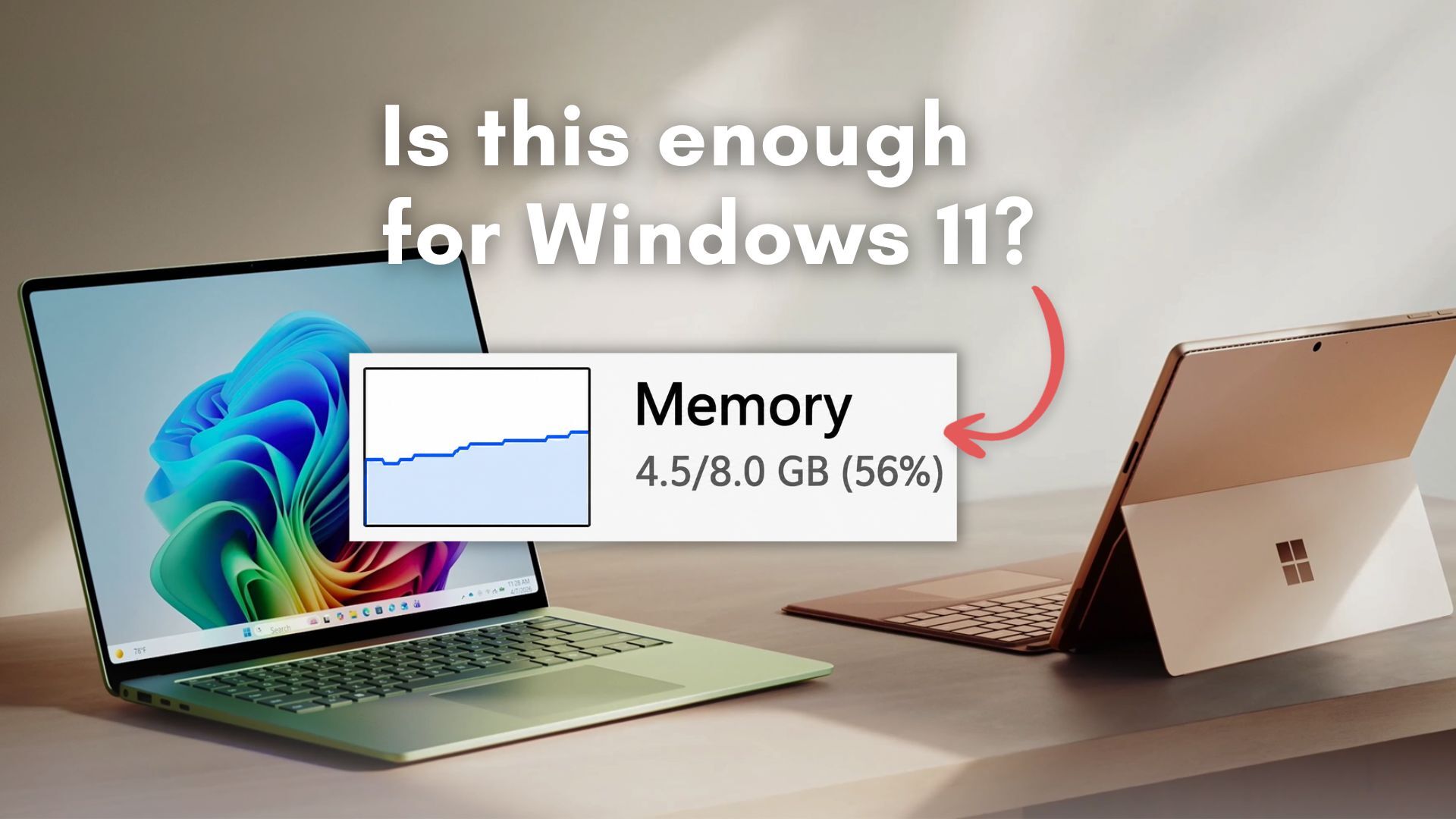
Windows 10 had a minimum requirement of 2GB RAM, with 4GB recommended for a comfortable experience. Windows 11 bumped that up and then kept needing more as the OS got heavier with every update cycle.
…to 4 GB…
I’ve used Windows 10 with 4GB. It’s not a comfortable experience. Neither is Windows 11 with 8GB.
I guess maybe 8GB is fine if all you do is have a browser open with some tabs… W11 is not RAM friendly.
I’d say 8G is fine until you open a browser.
and every application today is a browser.
next they’ll say any ol’ hdd is fine, too.
(they are not)
if you ever have to use win11 on a laptop with 4 or 8gb ram and a 2.5in hdd, you’ll be inventing new swear words.
I mean, as long as you pair it with an optane cache drive it should be fine
optane was a horrible and ineffective ‘solution’ to windows and application bloat.
I think the product was good. But it was too little too late, since nand SSD pricing had already begun to drop. If it had a higher capacity, or lower pricing, or was released sooner it would have been a hit.
I still use one for an os drive in my nas.
About halfway through the lifecycle for Windows 10, HDD performance became pure garbage and I genuinely do not know how/why they did that. Something about how they were handling indexing or read operations at idle meant pinning the disk at 100% usage almost all the time and the only solve was an SSD. I hate that shit so much.
I hope they have to rebase their os to win 7 due to ram prices
Don’t worry, soon they will announce that 4GB will probably be fine too, once they discover they need even more RAM for their AI slop farms.
Why would they knowingly push for better but unnecessary hardware? What do they gain from people buying more RAM than necessary to run Windows?
Edit: wait, they also sell laptops. Duh.
Kids, learn from my mistakes, read article first, comment second.
Nothing. It’s not unnecessary. It’s very necessary, especially Windows. They’re just shifting their perspective because RAM has gotten so wildly expensive.
they also provide the os on most systems sold by everyone else, too.