You must log in or register to comment.
Fuck no. https://en.wikipedia.org/wiki/Literacy_test
Between the 1850s and 1960s, literacy tests were used as an effective tool for disenfranchising African Americans in the Southern United States. Literacy tests were typically administered by white clerks who could pass or fail a person at their discretion based on race. Illiterate whites were often permitted to vote without taking these literacy tests because of grandfather clauses written into legislation.
If voting needed an exam, they would use that exam to stop certain demographics from voting. And no, I’m not talking about the ignorant.
Surely there are no examples in American history that voting eligibility exams were used to stop certain demographics from voting.
They used to do this and it turned out exactly how you describe. I would probably also add it’d incentivize politicians to dismantle educational institutions serving certain demographics
It is 100% used as a weapon to disenfranchise voters.
I do however believe that it should be used on CANDIDATES.
Who gets to design the test, though?
Me.
What that actually looked like:
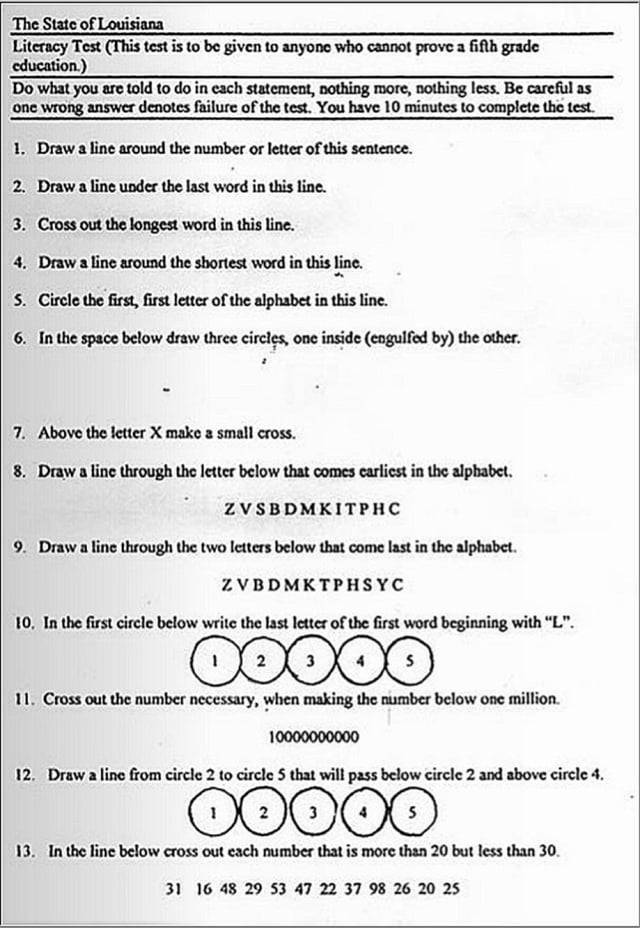
This is like the kryptonite of autistic people… and black voters whenever they had this…
Prove you’re literate by solving lateral thinking word puzzles.
There are two more pages to this and it gets worse
https://sharetngov.tnsosfiles.com/tsla/exhibits/aale/pdfs/Voter Test LA.pdf
This has the full thing and some explanation
Also worth pointing out, WHY the test is so bad… 1. obviously not even well educated people today can agree on the meaning of a good portion of the questions.
but the biggest thing is, not everyone had to take them… IE the key point intention was “if a parent or grandparent has ever voted, you can skip this test”. which is such a blatant giving away that they don’t care of an individuals knowledge, they aren’t actually worried if they can read, they were just keeping first generation voters from voting… at a time when in particular a specific subset of american’s were in position to be first generation voters.
(black people, particularly)
A perfectly designed test - ambiguous enough that anyone subjected to it can be failed.
I still don’t know what #11 is “supposed” to be.
You got enough answers but here’s how you deny someone the right to vote: the question really means you need to make the number 1000000 exact as that is the number “below” the question. Not fewer, physically below.
Oh good, now we have three completely different answers
Four. You need to make the number below (less than) one million, so cross out zeros until it’s 100,000.
”0000000” isn’t a properly formatted number.It’s a fun game finding the ways you can tell someone whatever they said is wrong.
I did my best. Do I get to vote?

Nope. The answer to number ten is ‘a’.
Assuming you went with “last”, but that starts with ‘l’, not ‘L’. Each other question also specifies “one this line” where relevant, but not this one. The first word starting with ‘L’ is “Louisiana”.
The trick of the test is that it’s subjective to the person grading it. I could have also told you that the line drawing one (12) was wrong by just saying it’s not the correct way to do it. Or that 11 was wrong because you didn’t make the number below one million, it’s equal to one million. Or if you crossed off one more zero I’d say you could have gotten fewer by crossing off the 1 at the start. Or that a long string of zeros isn’t a properly formatted number.
Sure. Disenfranchise most people. That’s a suitable hack to a
checks notes
stable, legitimate, and responsive government.Even China would have more political legitimacy than such a system. It would collapse almost immediately.
If you ever want a good example of functionalist ideas leading to absolutely uncritical nonsense, here it is.
Not saying this is the correct route, but I do see the cultural decay, foreign influence, and complete lack of civic duty causing massive political failures in the US in real-time as we grow lazier, less interested, and more content. Any idea how we account for that in a reasonable fashion?
You don’t. People have always said that about basically every country. What is “cultural decay”? Define “civic duty”. Why is it a problem that people are content? Are we lazier? Are people on average more content now?
The key lesson is that you can’t force people to care about what you do. Inspire people and they’ll follow you, don’t and they’ll do something else. FDR increased a sense of civic duty by paying people to do civic works.
I think I might’ve come across incorrectly when I said cultural decay. I mean to convey the consequences of a cultures effect on politics. For example wars, pollution, or nuclear weapons. I think you’d have trouble denying those have effects that are inherently social and require civic cooperation to prevent. Doing otherwise seems to me to actually objectively be a problem, assuming you value living. That’s actually what I meant about laziness as well, that we’re less invested in the core responsibilities that now exist with how advanced our technology and societies have become.
I agree you can’t force anyone, that’s not freedom, but I also feel and fear we may be past the point where inspiration can handle the challenges. FDR never had nuclear war looming, the interconnected and chaotic nature of social media to contend with, or a bevy of other modern factors like llms that I get the gut feeling are insurmontable. I’d like to be convinced otherwise instead of subscribing to apathy but I feel like I’m living through the dawn of a new age.
I’m glad it was a misunderstanding. :)
I think my central point still holds, so I’ll develop on it a bit more.
Every era has its challenges, and they’re all seemingly insurmountable and possibly the worst thing yet. They’re less significant from our perspective, but we have the benefit of history. We know how the story progressed.
FDR did have nuclear war looming, they just only knew that meant “bad”, but not the details. It was probably scarier then. We know now that he actually didn’t because the German program was doomed to failure from the start, but they didn’t at the time. They had an economy that was in tatters, a massive food shortage resulting in poorly quantified starvation, the most powerful militaries on the planet conquering Europe and Asia, and so on.
We’re past the age where the president is likely to be able to inspire unity of purpose like they did then, but that’s always been how you get people to care: someone needs to convince them, or you pay them. In a time if turmoil, you can inspire a lot of purpose by giving people a stable job, and then constantly extolling the virtues of the purpose they’re working towards.All that to say, we don’t know the future. You are living through the dawn of a new age. Our problems aren’t insurmountable, we just don’t know how to do it yet. The details are different, but it’s not a new circumstance.
I’m not an advocate for apathy, but… If it does go wrong, what actually happens? America collapses, war, people die, and turmoil. We can’t know the timeline, and we have 3/4 of those now with the remaining being pretty intangible. The fall of the Roman empire, depending on which fall you’re looking at, took 300 to a 1000 years. To the people living through the fall, it wasn’t even visible. The final fall ushered in the Renaissance, both a period of great development, but also pessimism born out of the proceeding centuries of turmoil (European peace shattered by 200 years of war, famine, several plagues, and an ice age). Injecting masses of fleeing scholars from Constantinople into that propelled things to new heights as their knowledge from the fallen empire blended with the local knowledge.
We don’t know if the empire is falling, how long it’s going to take, if we’re at the beginning or the end, or if we’re even in the empire. We don’t know if the collapse will trigger a dark age (not actually dark, just “not roman”), or a golden age as waves of American scientists, artists, writers, mathematicians and engineers take their work to China and unintentionally create a fresh blend of perspectives and shared knowledge that builds on both. (Stereotypes aside we have a lot of those).People problems are ultimately solvable by people, inevitably by talking.
History consistently tells us that it’s weird, messy, and long. Live life, be kind. If someone says to do something for other people for moral reasons, it’s a coin toss if they’re doing something history will look kindly upon. If someone says to do something for group identity, they’re probably fine. If they say to do something to someone else for group identity, they’re most likely not. If someone is saying something you’ve heard before but a lot of people are listening and the people in power don’t like it, thiniare probably shifting. Maybe not for the people speaking, but shifting.It’s late and I’m rambling as I fall asleep. When I say “you don’t”, I mean that history and society are too much to bend in a deliberate way. Best you can do is the right thing at the time as best you can and not worry too much about your role in the big picture. So few people have a role that sets them at the bend of those forces.
Also, I’m not too worried about LLMs and social media, fundamentally. People have been saying and believing bizarre shit forever, they just made it easier and faster. The fading lustre of the Internet is just a drift back a bit towards before it, when people just believed stuff and then no one ever corrected them.
This is a bad idea. You would just be creating another layer of gerrymandering.
I won’t call out of or the drawer for bad idea. The idea is fine. There’s just zero ways to ever implement it. It’s nice to dream though
Ehh… I think it’s fundamentally problematic. Why should only a subset of the adult population be allowed to vote on laws that affect everyone?
If there were a practical way to do it, a way to ensure that only those who were well informed on a topic could have a say in it wouldn’t be an issue. The only barrier to voting would be your desire to inform yourself.
Unfortunately there isn’t, because just about every word in the above sentences can be twisted by someone with illintent.
The concept isn’t fundamentally flawed, it’s just blocked by insurmountable obstacles.